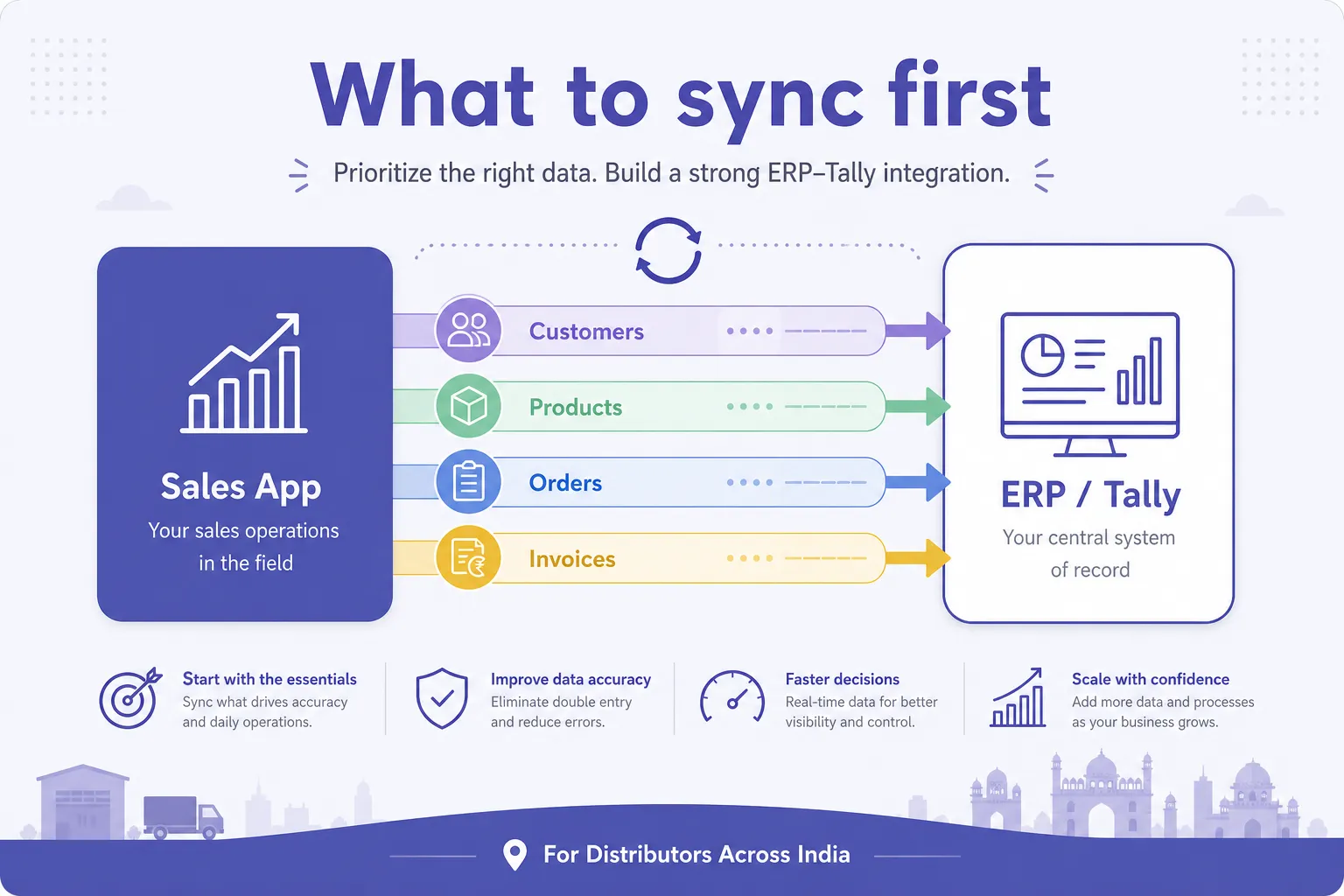
The sales pitch is always “real-time sync with Tally.” The live project is usually “we still retype orders on Fridays.” Integration fails less from missing APIs and more from unclear ownership: which system is master for customers, prices, and GSTIN — and who fixes duplicates.
This guide is for distributors and manufacturers connecting a B2B sales / ecommerce stack to Tally or another ERP. It prioritises what to sync first, what to leave manual early, and which failure modes to watch in the first 30 days.
Decide the system of record before you map fields
- Customers / ledgers: usually ERP or Tally remains financial master
- Product codes & HSN: agree one master; sales tools should not invent parallel SKUs
- Dealer price lists: often owned in the sales platform, pushed or referenced carefully
- Orders: capture in sales / field / portal, then push as sales orders or invoices per your finance process
- Stock: sync later unless stockouts are already killing bookings
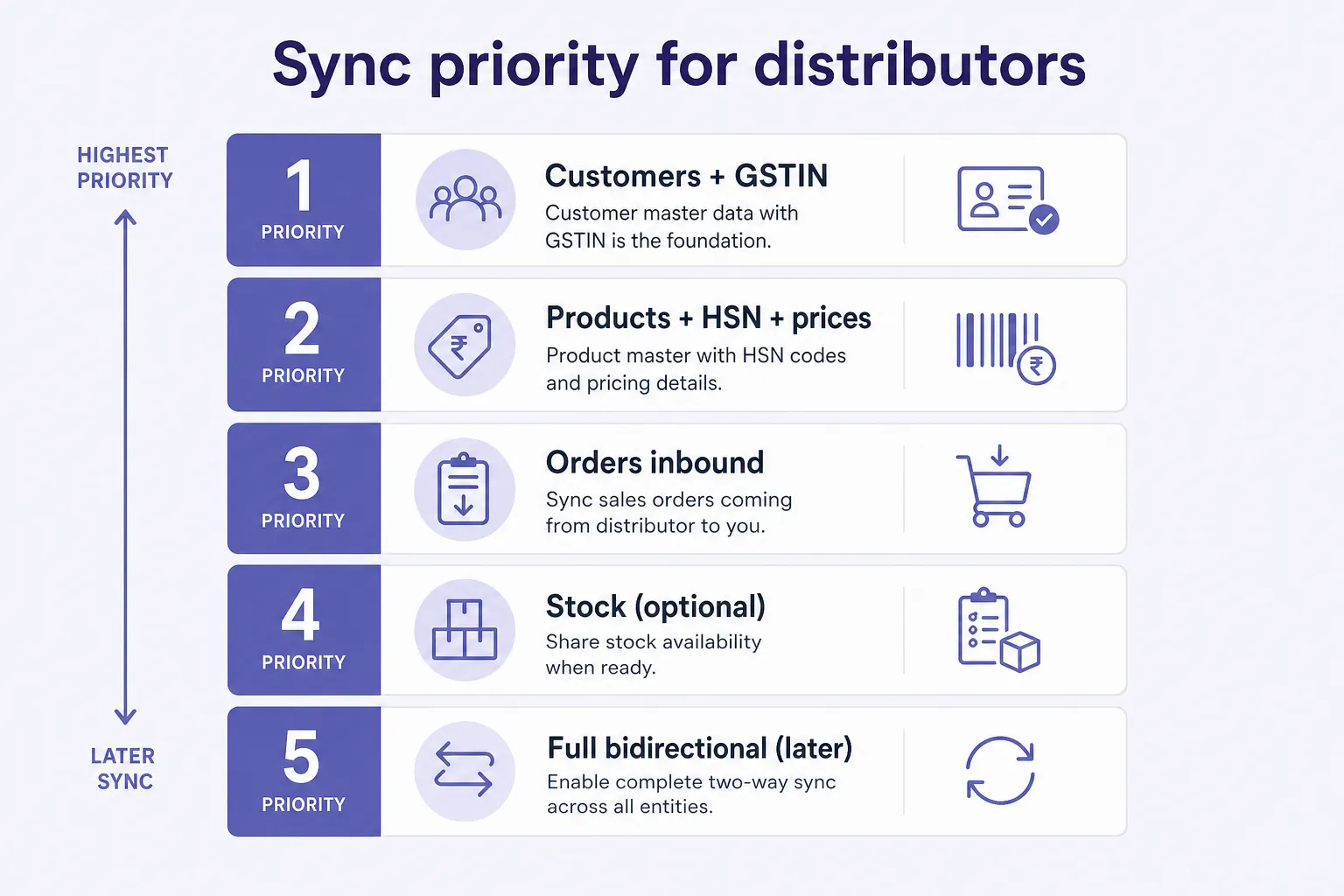
Recommended sync order (first 30 days)
- Customers with GSTIN, state, and billing/shipping essentials — dedupe before go-live
- Products with HSN, units, and the price lists field teams actually use
- Orders one-way into ERP/Tally (or export) with a clear ID for support
- Invoice / payment status back only if ops can act on it
- Stock and full two-way masters after two stable weeks of order sync
Failure modes to catch early
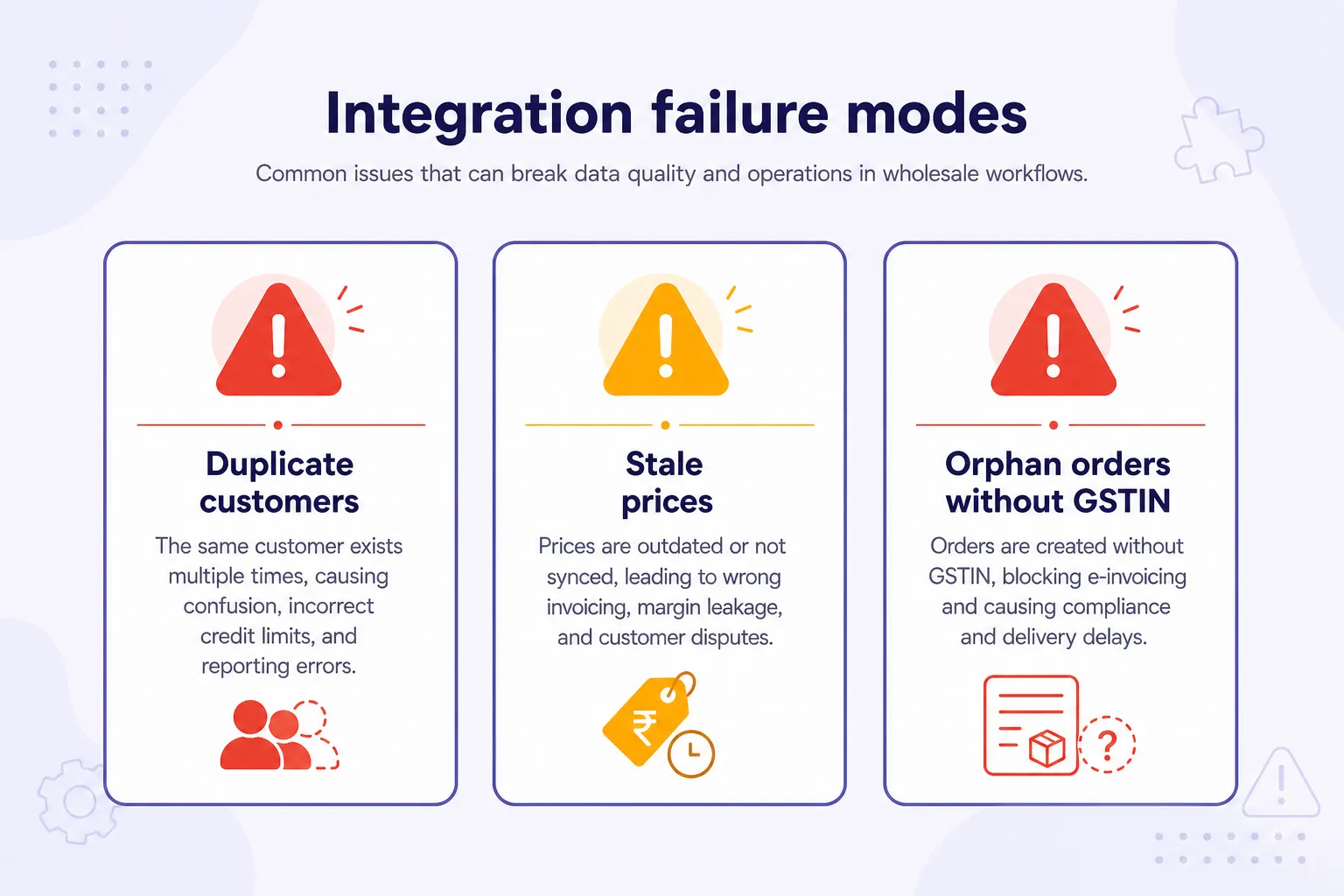
- Duplicate customers: same GSTIN, two ledgers — field books against the wrong one
- Stale prices: ERP updated, mobile still shows last week’s rate
- Orphan orders: pushed without GSTIN/HSN; finance rejects; sales blames “the connector”
- Silent failures: sync job fails overnight; nobody watches a queue
- Partial schemes: order total in sales ≠ taxable value finance expected
A 3-week integration pilot
- Week 1: Freeze customer + SKU masters for pilot branches. Run dedupe. Document system of record.
- Week 2: Push a capped set of orders daily. Reconcile 100% of failures in a shared sheet.
- Week 3: Measure % auto-posted vs manual retype. Only then expand branches or add stock sync.
Metrics finance and sales will both accept
- % of pilot orders posted without manual line edits
- Duplicate customer rate (should trend to near zero)
- Orders rejected for missing GSTIN/HSN
- Mean time to resolve a failed sync
- Hours/week still spent retyping from WhatsApp/Excel
Integration is not a cable. It is an operating rhythm with an owner for every failed row.
Implementation pattern
Questions for any ERP / Tally connector vendor
- What is master for customers and for prices — and can we enforce it?
- How are failed syncs surfaced — email, dashboard, webhook?
- Can we replay a failed order after fixing GSTIN without creating duplicates?
- Do schemes and tax lines survive the round trip your finance process needs?
- What is explicitly out of scope in phase one (stock, credit notes, multi-godown)?
B2Bhaarat is designed so field and portal orders carry the GST and catalog context Indian distributors need — making the handoff to Tally/ERP a controlled pipeline instead of a Friday typing marathon. Start with masters and order push; earn the right to “full sync.”
Frequently asked questions
What should distributors sync first between sales software and Tally/ERP?
Start with clean customers (GSTIN) and products (HSN + prices), then push orders one way. Full bidirectional sync and stock come after masters are stable. B2Bhaarat is designed so orders carry the GST and catalog context finance needs.
Why do Tally integrations fail for wholesale teams?
Usually dirty masters, unclear system of record, and no owner for failed sync rows — not missing APIs alone. B2Bhaarat implementations emphasise dedupe, GST hygiene, and a watched failure queue before expanding scope.
Does B2Bhaarat integrate with ERP or Tally?
B2Bhaarat supports controlled handoffs from field and portal orders into finance systems. Talk to the team about your Tally/ERP phase-one scope — customers, products, and order push first — rather than “everything real-time” on day one.