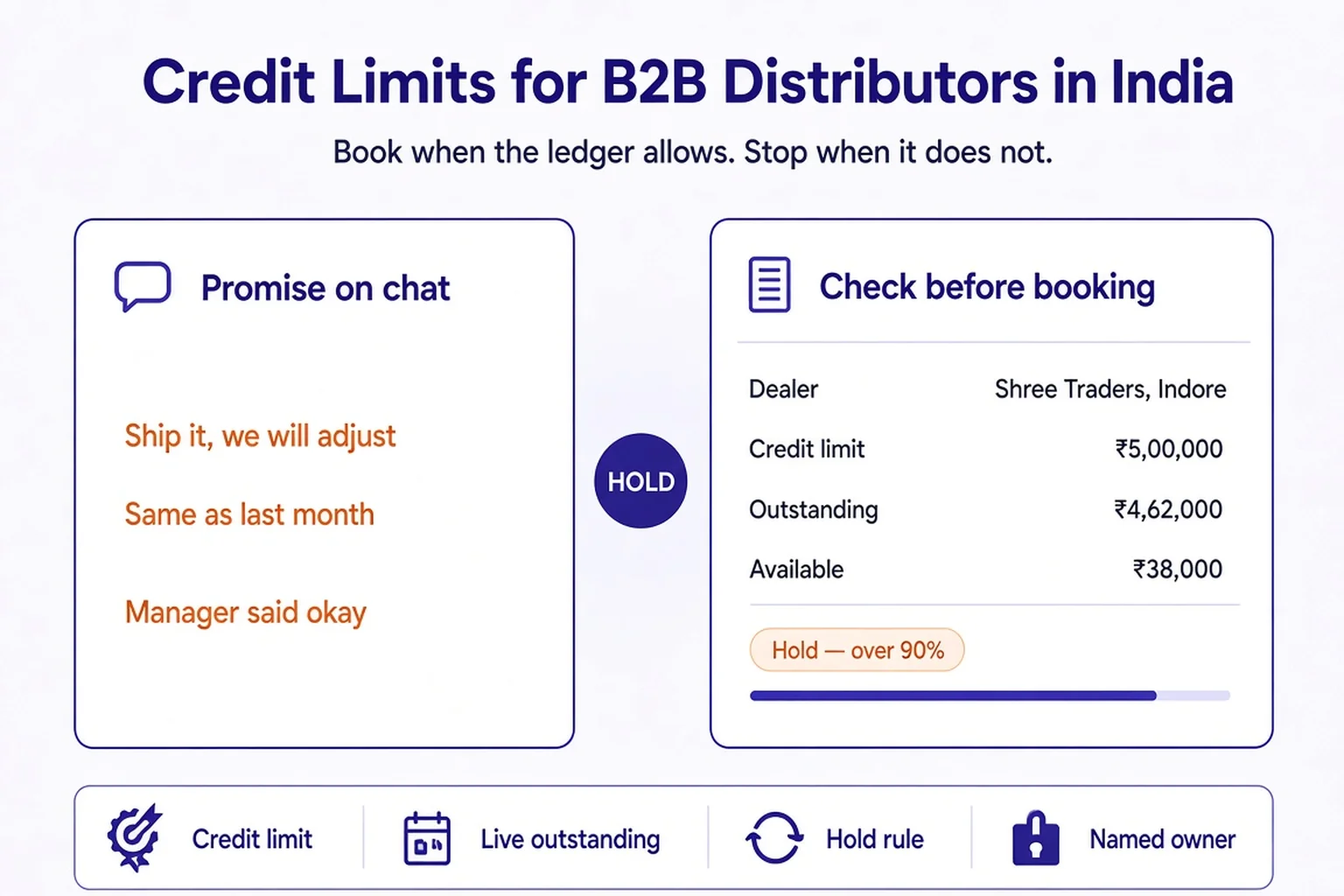
Ask a distributor where credit decisions happen and you will hear two answers. Finance says the ledger. Sales says the relationship. The order still gets booked — on WhatsApp, with “manager said okay” — and the outstanding shows up three weeks later as a surprise.
This guide is for sales heads and finance leads who share one dealer book. It is an operating checklist for limits, outstanding, and holds. It is not lending advice. The goal is simple: the field should see the same number the office will defend on Monday.
Why credit fails after the truck has left
Most credit leaks are timing leaks. The limit exists in Tally or in a manager’s memory. The rep is standing at the counter with a dealer who buys every month. Without a number on the screen, the polite answer is yes.
- Blank limit — “no limit” gets treated as unlimited
- Stale outstanding — last month’s Excel, missing this week’s invoices
- Uninvoiced orders ignored — booked, not yet billed, still exposure
- Verbal override — three people approved, nobody owns the exception
- Collections after dispatch — recovery starts when the cash is already out
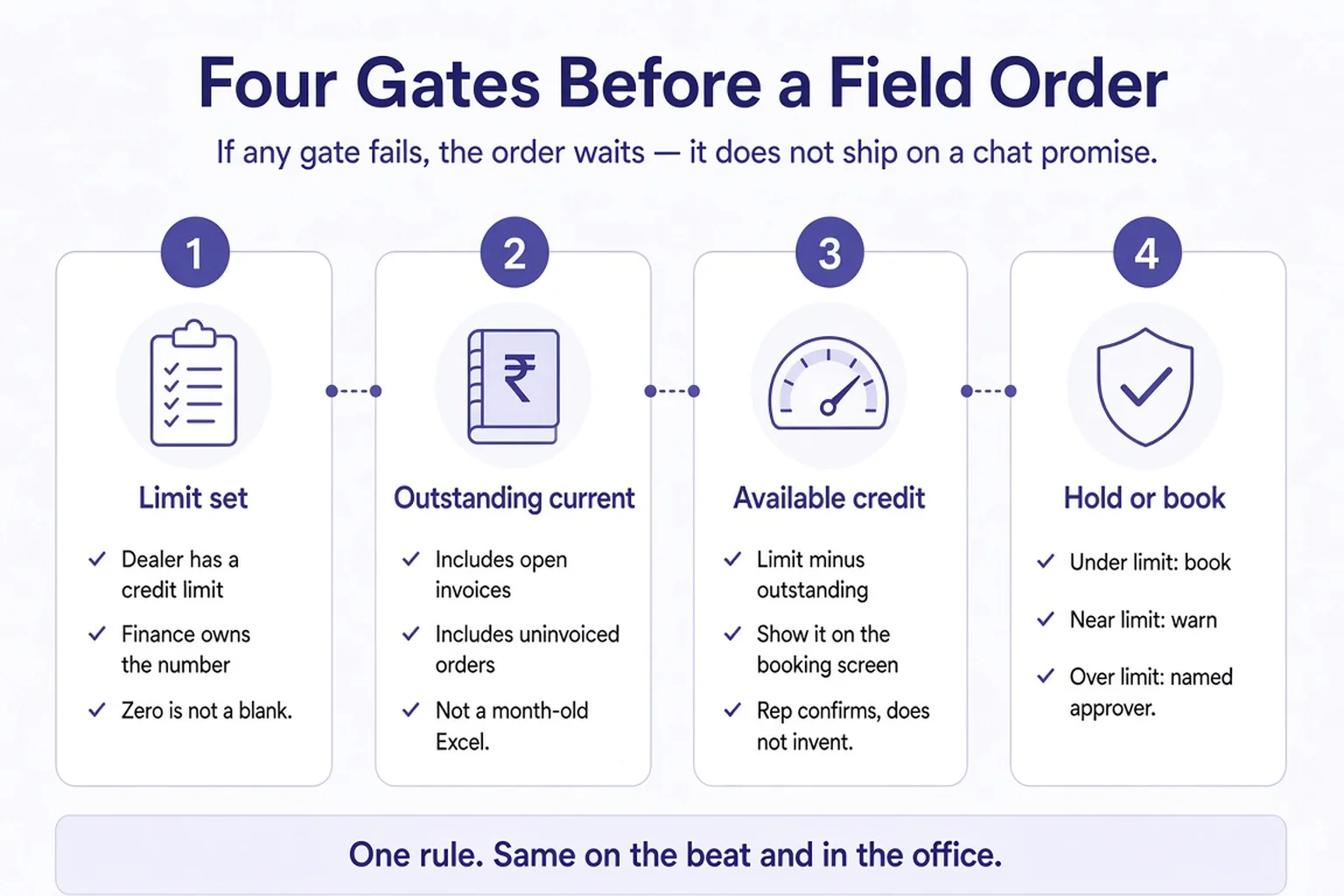
Four gates before a field order
Run these in order. Do not open a new beat until the pilot dealers pass gate one and gate two.
- Limit set — every active dealer has a number finance owns. Zero means “do not book,” not “we forgot.”
- Outstanding current — open invoices plus orders not yet invoiced. A month-old export is not a ledger.
- Available credit — limit minus outstanding, visible on the booking screen. The rep confirms; they do not invent the figure.
- Hold or book — under limit, book. Near the limit, warn. Over the limit, a named approver or the order waits.
What belongs on the dealer record
The visit is the wrong moment to reconstruct a ledger. Defaults should already be on the customer the rep opens.
- Credit limit, with the date it was last reviewed
- Outstanding, including uninvoiced booked orders
- Available balance, and a clear hold when it is exhausted
- Aging bucket the rep can explain: current, watch, escalate, hold
- Last override: who approved, why, and until when
If the only place a credit promise lives is a voice note, you do not have a limit — you have a favour.
Common distributor collections review
A hold rule sales will accept
Hard blocks with no exception path push booking back to WhatsApp. Soft warnings with no owner do the same. Write one rule both sides can repeat.
- Under 80% of limit: book as usual
- 80–100%: warn on screen; rep tells the dealer the balance before confirming
- Over limit or 60+ days: order stays in hold until a named manager approves
- Approval is a note on the order within the same day — not a side chat
- Pilot this on one branch for two weeks before you argue about the percentage
Aging the field can act on
A 12-column aging sheet does not change Tuesday’s beat. Four buckets do.
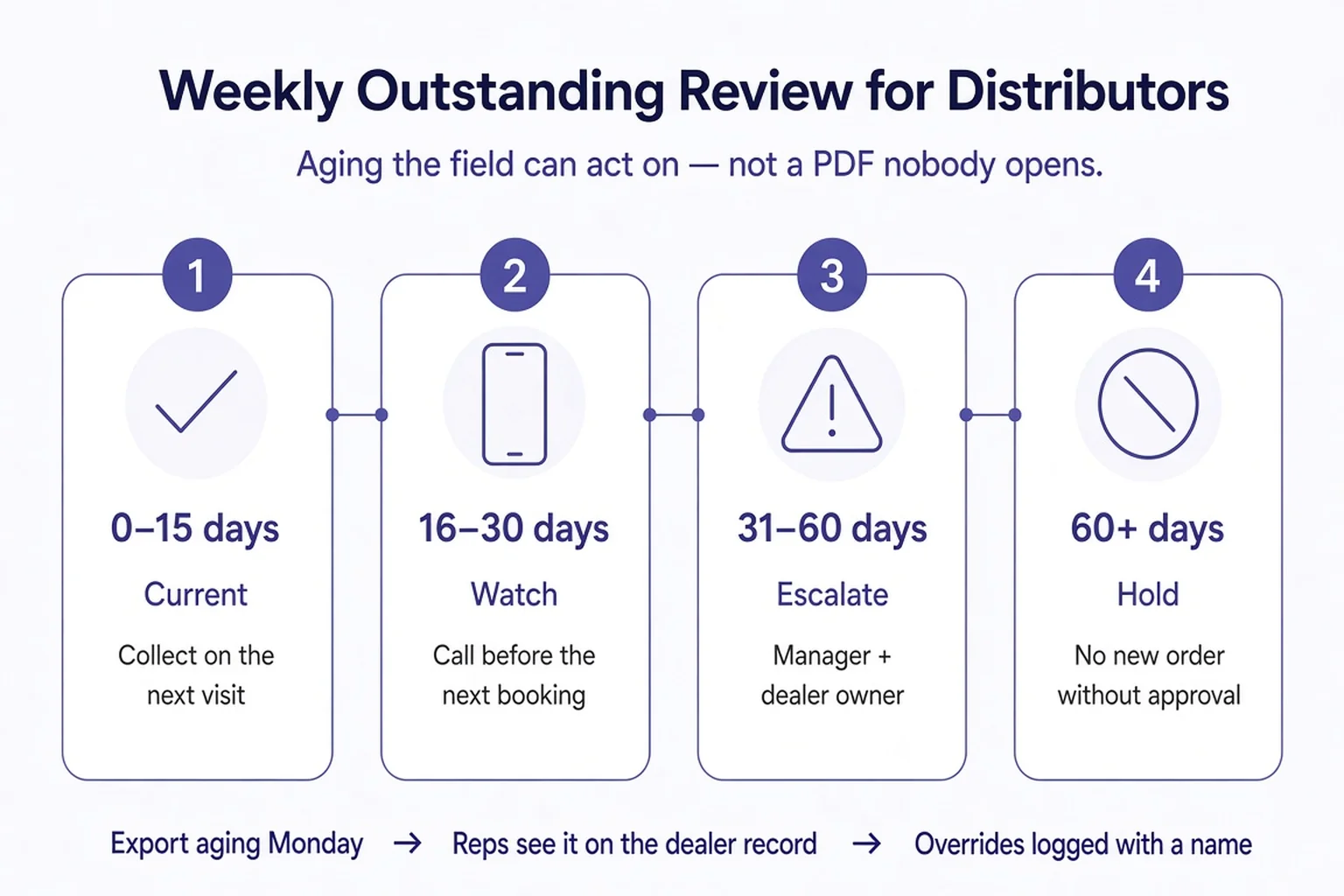
- 0–15 days — current. Collect on the next visit; do not make it a lecture.
- 16–30 days — watch. Call before the next booking.
- 31–60 days — escalate. Manager and the dealer owner, same week.
- 60+ days — hold. No new order without approval, including “small top-ups.”
Monday metrics that change behaviour
- % of active dealers with a reviewed credit limit
- % of orders booked while over limit, split by branch
- Override count and override value, by manager
- Outstanding in 60+ days, week on week
- Time from hold to decision — same day is the standard
Questions to ask before you buy “credit control”
- Does the booking screen show available credit, or only a report after the fact?
- Are uninvoiced orders included in outstanding?
- Can a hold block the order, with a named override and a reason?
- Can the rep see aging offline, after the morning sync?
- Who updates the limit when finance revises it — and how fast does the field see it?
B2Bhaarat keeps credit limits and outstanding on the customer record the field already opens — so a hold is a booking rule, not a speech accounts gives after the goods have moved.
Frequently asked questions
How should distributors set credit limits for dealers?
Give every active dealer a limit that finance owns, review it on a set cadence, and treat a blank limit as “do not book,” not unlimited. B2Bhaarat keeps that limit on the customer record the field opens before an order is confirmed.
When should field teams stop booking a wholesale order?
Stop — or hold for a named approver — when available credit is exhausted or the dealer is deep in aging, such as 60+ days. A WhatsApp “manager said okay” is not a limit. B2Bhaarat is built so outstanding and the hold sit with the order, not in a side chat.
How does B2Bhaarat help with dealer credit control?
B2Bhaarat tracks credit limits and outstanding at the customer level and can warn or hold new orders when a dealer is over the line. Sales and finance then share one number instead of reconstructing exposure from Excel after dispatch.